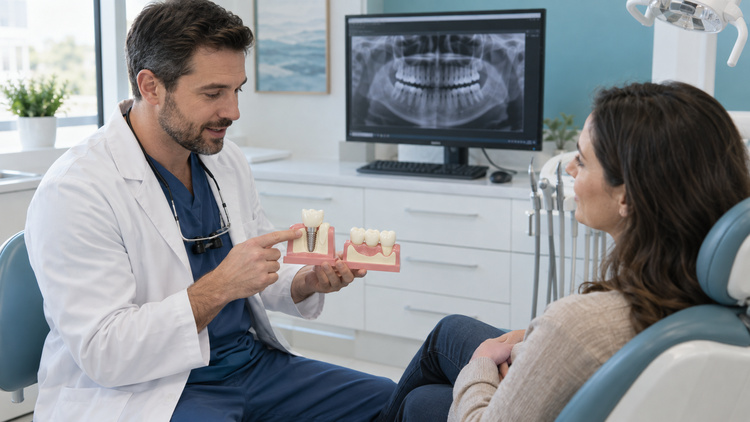
Neither a dental implant nor a bridge is automatically the better choice for every missing tooth. A dental implant replaces the missing tooth root and supports a separate replacement tooth, while a traditional dental bridge fills the gap by using neighbouring teeth for support. The right option depends on the health of the adjacent teeth, available jawbone, your general health, treatment preferences, maintenance needs and budget.
If the teeth beside the gap are healthy, a dental implant may allow them to remain untouched. A bridge does not require implant surgery, but a traditional bridge normally requires the supporting teeth to be prepared for crowns. A dental examination and appropriate X-rays are needed before deciding which approach is suitable.
Dental Implant vs Bridge: Quick Comparison
| Factor | Dental Implant | Traditional Dental Bridge |
|---|---|---|
| How the replacement is supported | An implant is placed in the jawbone and supports the replacement tooth | The replacement tooth is supported by neighbouring teeth |
| Adjacent teeth | Usually does not require preparing healthy neighbouring teeth | Supporting teeth are generally prepared for crowns |
| Surgery | Requires implant placement surgery | Does not require implant surgery |
| Jawbone | Adequate bone is needed, although bone grafting may sometimes be possible | Does not require bone to support an implant |
| Treatment stages | Usually involves several stages and a healing period | Commonly involves preparation, impressions or scanning, a temporary restoration and placement of the final bridge |
| Cleaning | Requires brushing, cleaning around the implant and regular dental care | Requires cleaning around and underneath the bridge as well as the supporting teeth |
| Best choice | Depends on the condition of your teeth, gums, bone, health and treatment priorities | |
What Is a Dental Implant?
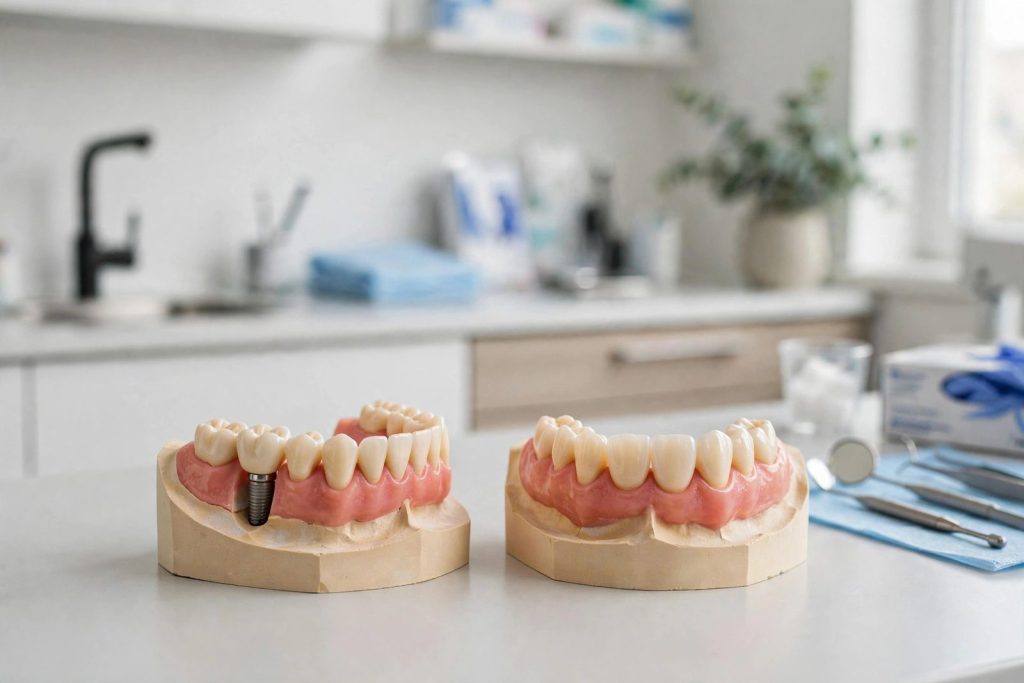
A dental implant is an artificial tooth root, typically made from titanium, that is placed into the jawbone. After the implant has integrated with the surrounding bone, an abutment and replacement tooth can be attached.
The Canadian Dental Association notes that implants can be used to replace missing roots and support artificial teeth. Implant treatment usually involves an assessment, surgical placement, healing and placement of the final restoration.
Learn more about dental implants in Newmarket. When patients weigh a dental implant vs bridge, the implant’s biggest advantage is that it stands on its own, without relying on the teeth beside the gap.
What Is a Dental Bridge?
A dental bridge is a fixed restoration that replaces one or more missing teeth by spanning the gap. In a traditional tooth-supported bridge, the artificial tooth is connected to crowns placed over the neighbouring teeth.
According to the Canadian Dental Association, the teeth beside the missing tooth are typically prepared before the bridge is made and cemented into place. Other bridge designs, including resin-bonded, cantilever and implant-supported bridges, may be considered in specific situations.
Learn more about dental bridges in Newmarket. In a dental implant vs bridge comparison, the bridge is often the faster route, since it does not involve surgery or a healing period before the final tooth is placed.
How Do Dental Implants and Bridges Differ?
1. Effect on the Teeth Beside the Gap
One of the main differences is how the restoration receives support.
A single dental implant is supported by the implant itself. It usually does not require healthy teeth beside the space to be reshaped.
A traditional bridge generally relies on teeth beside the gap. The Canadian Dental Association explains that these supporting teeth are prepared for the crowns that hold the bridge in place.
This difference can be particularly important when both neighbouring teeth are healthy and have little or no previous restorative work.
2. Surgery and Treatment Process
Dental implant placement is a surgical procedure. The implant is positioned in the jawbone and needs time to heal and integrate before the final replacement tooth can be completed. The Canadian Dental Association notes that implant healing can take several months and that several appointments may be required.
A traditional bridge does not require implant surgery. The supporting teeth are prepared, an impression or digital scan is taken and a temporary bridge may be used while the final restoration is made.
The actual timeline for either option varies according to the condition of the mouth, treatment complexity and any additional procedures required.
3. Jawbone Requirements
An implant needs enough healthy bone for support. Your dentist assesses the area clinically and with appropriate imaging before recommending implant placement.
If the jawbone has reduced in volume, implant treatment is not automatically ruled out. In some cases, bone grafting may be considered to improve the available bone before or during implant treatment.
A traditional tooth-supported bridge does not need jawbone to hold an implant because the restoration is anchored to neighbouring teeth. However, the supporting teeth and gums still need to be suitable for the restoration.
4. Bone Around the Missing Tooth
A natural tooth root transmits forces to the surrounding jawbone. When a tooth is lost, changes in the bone can occur over time.
A single-tooth implant replaces the missing root as well as supporting the visible replacement tooth. The American Academy of Periodontology notes that this can help preserve bone in the missing-tooth area.
A conventional bridge replaces the visible tooth but does not place a root replacement into the empty socket.
5. Cleaning and Maintenance
Neither option is maintenance-free.
Dental implants need consistent brushing, cleaning between the teeth and professional monitoring. The gums and tissues around an implant can develop problems if plaque is not controlled.
With a bridge, the supporting teeth require careful cleaning and the area beneath the artificial tooth also needs to be cleaned. Your dental team may recommend a floss threader, interdental brush or another device depending on the bridge design.
6. Repair and Replacement Over Time
Both implants and bridges require ongoing dental care, and neither should be described as permanent for every patient.
The Canadian Dental Association states that a well-cared-for bridge can generally last about 10 years or longer. Its lifespan can be affected by the condition of the supporting teeth, decay, gum health, bite forces and oral hygiene.
Implants can also function for many years, but implant treatment can experience complications such as infection, bone loss, loosening of components or failure to integrate with the bone. The crown or other restoration attached to an implant may also require repair or replacement over time.
Which Option Costs More: an Implant or a Bridge?
There is no single fee that applies to every implant or bridge case.
Implant treatment may involve surgical placement, implant components, a crown and, in some cases, bone grafting or other procedures. The Canadian Dental Association notes that implants can cost more than some other tooth-replacement options and may not be covered by every dental plan.
The cost of a bridge varies according to the bridge design, number of teeth involved, materials used and condition of the supporting teeth.
Insurance and benefit plans also differ. Before treatment begins, ask for a treatment estimate and confirm what your plan may cover and what amount you may need to pay directly.
When Might a Dental Implant Be Considered?
A dental implant may be considered when replacing a missing tooth and the surrounding conditions are suitable. Factors your dentist may assess include:
- the health of your gums;
- the amount and quality of jawbone in the area;
- the condition of the teeth beside the gap;
- your general health and medical history;
- your ability to maintain oral hygiene;
- your bite and the location of the missing tooth; and
- whether implant surgery is appropriate for you.
The Canadian Dental Association states that healthy gums and sufficient jawbone are important considerations for implant treatment. Bone grafting may sometimes be possible when bone volume is inadequate.
When Might a Dental Bridge Be Considered?
A dental bridge may be considered when the teeth around a missing-tooth space can provide appropriate support and a fixed restoration is suitable for the area.
A bridge may also be discussed when implant surgery is not appropriate or is not the patient’s preferred treatment. The type of bridge that may work depends on the number and location of missing teeth and the condition of the supporting teeth and gums.
Because traditional bridges require preparation of neighbouring teeth, their existing condition is an important part of the treatment decision.
What If the Teeth Beside the Gap Are Healthy?
This is an important part of the implant-versus-bridge decision.
The Canadian Dental Association specifically notes that a single implant can replace a missing tooth between two healthy teeth without requiring those teeth to be filed down for supporting crowns.
That does not mean an implant is automatically the correct treatment. Bone availability, medical factors, surgery, cost and patient preference still need to be considered.
What If There Is Not Enough Bone for an Implant?
Insufficient bone does not always eliminate implant treatment as an option. The Canadian Dental Association notes that some patients may be able to have a bone graft to build up the jawbone before implant placement.
Whether grafting is appropriate depends on the amount and location of bone loss, the planned implant and other clinical factors. An examination and dental imaging are required before making that decision.
Dental Implant or Bridge for a Front Tooth?
Replacing a front tooth involves more than filling the visible space. The dentist may need to evaluate the gum line, available bone, position of neighbouring teeth, bite and appearance of the final restoration.
Both implants and certain bridge designs can be used in the front of the mouth. The appropriate option depends on the clinical situation rather than appearance alone.
Dental Implant vs Bridge: How Is the Decision Made?
The decision is usually made after examining the missing-tooth area and the structures around it. A dental examination may include an assessment of the gums, neighbouring teeth, bite and jawbone, along with X-rays or other imaging when appropriate.
Your dentist can then explain which treatments are clinically possible, what each option involves and the trade-offs that matter in your case.
Frequently Asked Questions
The dental implant vs bridge decision usually comes down to the health of the neighbouring teeth, the amount of jawbone available, and how you feel about surgery — the questions below walk through each factor.
Is a dental implant better than a bridge?
Not for every patient. An implant can replace a missing tooth without preparing healthy neighbouring teeth and can replace the missing root, but it requires surgery and adequate bone. A bridge avoids implant surgery but usually depends on neighbouring teeth for support. The better option depends on your individual clinical situation.
Does a dental bridge damage the teeth beside it?
A traditional bridge requires the supporting teeth to be reshaped so crowns can fit over them. This is an intentional part of the procedure rather than accidental damage. Whether this is appropriate depends on the condition of those teeth and the overall treatment plan.
Which takes longer, a dental implant or a bridge?
Implant treatment generally involves a surgical placement and a healing period before the final restoration is completed. The Canadian Dental Association notes that implant healing can take several months. A traditional bridge follows a different process and does not require implant integration with the jawbone. Individual treatment times vary.
Which lasts longer, an implant or a bridge?
There is no guaranteed lifespan for either treatment. The Canadian Dental Association notes that bridges can generally last about 10 years or longer with good care. Implant longevity depends on factors such as oral hygiene, gum and bone health, bite forces, general health and ongoing professional care.
Can a dental bridge be replaced with an implant later?
Sometimes. Whether an implant can later replace a bridge depends on the available bone, condition of the neighbouring teeth, gum health and other clinical findings. A dentist needs to examine the area before confirming the options.
Can both an implant and a bridge replace one missing tooth?
Yes, depending on the clinical situation. A single implant with a crown and a traditional tooth-supported bridge are both established approaches for replacing a single missing tooth. The appropriate choice depends on the surrounding teeth, bone and individual treatment considerations.
Considering an Implant or Dental Bridge in Newmarket?
Eagle Family Dentistry provides dental implant and dental bridge services in Newmarket. A dental assessment can help determine which tooth-replacement options may be appropriate for the condition of your teeth, gums and jawbone. Still deciding between the two? Our homepage explains how our Newmarket dental team plans treatment after an assessment.