
Implant Crown Newmarket
An implant crown is the visible, tooth-shaped part of a dental implant restoration — the part you chew with and the part people see when you smile. It is custom-made for your mouth and attached to a titanium implant that replaces the missing tooth’s root. At Eagle Family Dentistry in Newmarket, your implant crown Newmarket treatment is planned and placed by our general dentists as one complete treatment: implant, connecting abutment and crown, sequenced over several visits.
This page is for patients planning that treatment, and for patients who already have an implant and need its final crown. Either way, you will find what an implant crown is, how the process works and how long it honestly takes, who it suits, and what to ask before you decide.
+1 (905) 836-6111

Book an Appointment
Implant Crown for Newmarket patients
Free consultation for dental implant treatment
Implant, abutment and crown planned as one treatment, at one office
Care from general dentists licensed in Canada

Replacing a Missing Tooth with an Implant Crown in Newmarket
A missing tooth is more than a gap in your smile. The teeth beside it drift, the tooth opposite it over-erupts, chewing shifts to the other side, and the jawbone under the gap slowly shrinks because it no longer has a root to support. An implant crown addresses the whole problem: the implant replaces the root, and the crown restores the tooth you bite with — shaped and coloured to match the teeth around it.
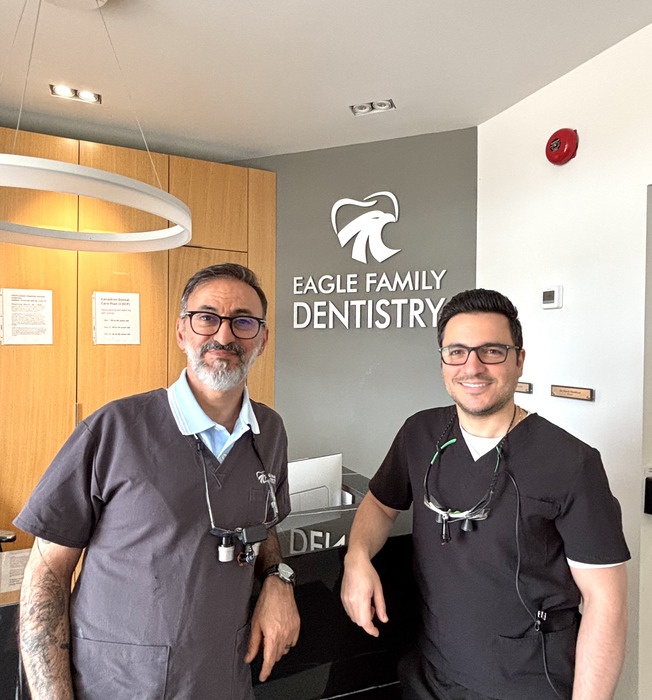
At Eagle Family Dentistry, implant crown treatment is provided by our general dentists, Dr. Saeed Meshksar and Dr. Meysam Jahanmehr. It begins with an assessment of your mouth, your bone volume and your general health, because an implant crown is the right answer for many missing teeth — but not all of them, and not at every moment. If a bridge or another option would serve you better, or if preparatory treatment is needed first, your dentist will explain that before anything is planned. To start the conversation about implant crown Newmarket treatment, call our office at (905) 836-6111 and ask about a free consultation for dental implant treatment.
What Are Implant Crowns?
An implant crown is a custom-made, tooth-shaped cap that is attached to a dental implant. The implant itself is a small titanium post placed in the jawbone, where it integrates with the bone and acts as an artificial tooth root. A connecting piece called an abutment sits on top of the implant, and the crown is secured to the abutment — by cement or by a small screw, depending on the case. The crown is the only part you see, and it is made in a dental laboratory to match the shape, size and colour of your natural teeth.
An implant crown is different from a crown on a natural tooth: a regular crown repairs a tooth that is still there, while an implant crown replaces a tooth that is missing entirely. It is also different from the implant itself, which sits below the gum and never shows. Where several teeth in a row are missing, implants can support a bridge instead of individual crowns — your assessment will show which approach fits your situation.
The Steps to Your New Implant Crown
- Consultation: Your implant crown process begins with a consultation and assessment. Your dentist examines your teeth and gums, reviews X-rays (and 3D imaging where needed), checks the bone volume where the tooth is missing, and discusses your goals and your general health. You will learn whether an implant crown is suitable for you, what the stages are, and the cost your dentist confirms after the assessment. Consultations for dental implant treatment are free.
- Placing the implant: If you decide to proceed, the titanium implant is placed into the jawbone in a surgical appointment, under local anaesthesia. Then comes the stage patients most often underestimate: healing. Over the following weeks to months, the bone grows around the implant and locks it in place — a process called osseointegration. Rushing this stage risks the whole treatment, so your crown is not attached until your dentist confirms the implant is stable.
- Attaching the abutment: Once the implant has integrated, a small connecting piece — the abutment — is attached to it. Sometimes this is done at the placement appointment, sometimes as a short separate step after healing; your dentist will tell you which applies to you. The abutment is the support your crown will sit on.
- Creating the crown: With the abutment in place, we take a precise impression or digital scan of your mouth, including the implant’s exact position, and choose a shade matched to your natural teeth. The dental laboratory then crafts your crown to fit the space, your bite and your smile.
- Attaching your crown: At the final visit, your crown is tried in and checked — the fit against the gum, the contact with neighbouring teeth, and your bite — then secured to the abutment. Your dentist will show you how to clean around it, because an implant crown needs daily care just as a natural tooth does.
Benefits of an Implant Crown — and Its Limits
An implant crown is worth considering for honest, practical reasons:
- A natural appearance: The crown is made for your mouth — its shape and shade matched to the teeth beside it — so it blends into your smile rather than announcing itself.
- Durability, stated honestly: An implant crown is built to last for many years, and the implant beneath it can last far longer with good care. No restoration is permanent or guaranteed, and the crown itself may eventually need repair or replacement — your dentist will give you a realistic expectation for your case.
- Restored function: Because the crown is anchored in the jaw rather than resting on the gum, you can bite and chew with it much as you would with a natural tooth, and speak without worrying about a denture moving.
- It protects the teeth around it: Unlike a traditional bridge, an implant crown does not require the neighbouring healthy teeth to be ground down to hold it — they are left untouched.
The limits matter too. Implant crown Newmarket treatment takes months, not days, because of the healing stage. It involves surgery, which not every patient is ready for. And it is not suitable for everyone: insufficient bone (which sometimes can be addressed with bone grafting), uncontrolled health conditions, or heavy smoking can all change the plan or the timing. The assessment exists to weigh these factors openly before you commit to anything.
Is an Implant Crown Right for You?
An implant crown may be right for you if you are missing one tooth (or a few individual teeth), your gums are healthy, and you are looking for a fixed replacement that you clean like a natural tooth and never take out. It may not be the right treatment — or not yet — if the gap is recent and the site is still healing, if gum disease needs treating first, or if a simpler option would meet your needs just as well.
The way to find out is an assessment, not a guess. At Eagle Family Dentistry in Newmarket, your implant crown Newmarket treatment is planned and carried out by general dentists licensed in Canada and regulated by the Royal College of Dental Surgeons of Ontario, and members of the Ontario Dental Association. For patient information about dental implants and restorative dentistry, the Canadian Dental Association is a reliable source. If you are exploring implant crown Newmarket treatment to replace a missing tooth, call us at (905) 836-6111 and ask about a free consultation for dental implant treatment.
Patients considering implant crown Newmarket treatment ask us these questions most often. If yours is not here, call us at (905) 836-6111.
?
FAQs About Implant Crown Newmarket Procedures
What problems does an implant crown solve?
An implant crown replaces a tooth that is missing, or a tooth that cannot be saved and needs to be removed. It is most often used for a single missing tooth, where it fills the gap without touching the healthy teeth on either side. Implants can also support several crowns, or hold a removable denture firmly in place so it does not shift when you eat or speak. Whether an implant crown is the right solution for your gap depends on your bone volume, gum health and general health — which is what your dentist checks at your implant crown Newmarket assessment.
What is the difference between an implant crown and a regular crown?
A regular crown repairs a tooth that is still in your mouth: it caps a natural tooth that has cracked, worn down or had root canal treatment, using the tooth’s own root for support. An implant crown replaces a tooth that is gone entirely: it sits on a titanium implant placed in the jawbone, which acts as an artificial root. The two crowns are made of similar materials and look alike, but what holds them up is completely different — and so is the process and timeline, which is why the options are assessed separately.
How long does the whole implant crown process take?
Honestly: months, not days. The sequence is a consultation and assessment, the implant placement appointment, a healing period of weeks to months while the implant integrates with your jawbone, and then the visits to attach the abutment and fit your crown. The exact timeline depends on where the tooth is, how much bone you have, and whether any preparatory treatment — an extraction that needs to heal first, or bone grafting — is required. Anyone who promises you a finished implant crown in a single day is skipping the healing stage your implant needs to succeed. At your consultation, your dentist will map out a realistic timeline for your specific case.
Does getting an implant crown hurt?
The implant is placed under local anaesthesia, so the area is numb during the procedure itself. We will not promise a completely pain-free experience: it is normal to have soreness, some swelling and tenderness for several days afterwards as the site heals, usually managed with standard pain relief and a soft diet. The later steps of your implant crown Newmarket treatment — attaching the abutment and fitting the crown — are minor by comparison and usually need little or no anaesthesia. If you feel anxious about the surgical appointment, tell us when you book; we will explain each step in advance and plan an unhurried visit.
How long does an implant crown last?
With good care, an implant crown commonly serves for 10 to 15 years or longer, and the implant post beneath it can last much longer still — often decades. Nothing in dentistry is guaranteed for a lifetime, though. The crown is a working part: it can chip, wear, or loosen over the years, and it may eventually need repair or replacement even when the implant itself remains solid. What protects your implant crown Newmarket investment is daily cleaning around the crown (including under its edges), regular check-ups so problems are caught early, and a night guard if you grind your teeth.
Am I a candidate for an implant crown?
You may be a candidate if you are missing a tooth, your gums are healthy, and you have enough jawbone where the tooth was lost to hold an implant. You may need treatment first — or a different plan — if you have active gum disease, if the bone at the site has shrunk significantly (bone grafting can sometimes rebuild it), if you smoke heavily (smoking slows healing and raises the risk of implant failure), or if you have a health condition or medication that affects bone healing. Age alone is rarely the deciding factor. The only way to know is an assessment with imaging, after which your dentist will tell you plainly whether an implant crown suits you — and if not, what would.
I already have an implant that was placed somewhere else — can you make its crown?
In many cases, yes — but it depends on identifying the implant system and size precisely, because components are not interchangeable between implant brands. If you have any records from your implant placement (the system, diameter and date), bring them; where records are unavailable, your dentist will assess what can be determined from examination and X-rays, and explain the options honestly before any cost is committed. If the implant itself turns out not to be ready or healthy enough to crown, you will be told that first, along with what can be done about it.
How much does an implant crown cost?
We do not publish prices, because the cost depends on your individual case: whether the failing tooth still needs to be removed, whether bone grafting is required, the type of abutment and crown, and the laboratory work involved. Implant crown treatment is also staged — implant, healing, abutment, crown — and your plan will set out what each stage involves. After your assessment, your dentist confirms the cost of your recommended treatment with you before anything begins. Consultations for dental implant treatment are free, so you can explore whether an implant crown is right for you and what your plan would involve before committing to treatment.
Does insurance or the CDCP cover an implant crown?
Private dental plans vary: some contribute to parts of implant treatment (the crown, for example) and exclude others, and many have waiting periods or annual maximums that matter for staged treatment — bring your plan details and we will help you confirm what applies before you start your implant crown Newmarket treatment. The Canadian Dental Care Plan (CDCP) is clearer, and it is important to know before you plan around it: dental implants are not part of standard CDCP coverage, so an implant crown is generally not a CDCP-covered treatment. CDCP coverage in any case is assessed against your eligibility first and follows the CDCP fee guide. Official plan details are on Canada.ca, and our team can explain how the plan interacts with other treatments you may need.
Need More Information?
Explore Our Diverse Dental Services


Dental Crowns
A custom-made cap that rebuilds a cracked, worn or root-treated natural tooth, restoring its strength, shape and appearance.


Dental Implants
Dental implants replace missing tooth roots and support crowns, bridges or dentures that look and work like natural teeth, restoring both the health and the appearance of your smile.


Dental Bridges
A bridge replaces one or more missing teeth by anchoring natural-looking replacement teeth to the crowned teeth on either side of the gap.