


Emergency Dentistry
Toothache, swelling, a broken tooth or a lost filling should not wait. Call our office, describe what is happening, and our team will advise you and offer the next available appointment. For anything life-threatening — uncontrolled bleeding or trouble breathing or swallowing — call 911 or go to the nearest emergency department.


Dental Implants
An implant replaces the root of a missing tooth and supports a crown that looks and works like a natural tooth. Whether an implant is right for you depends on your bone, gums and overall health, so treatment always begins with an assessment. Consultations for dental implant treatment are free.


Cosmetic Dentistry
Cosmetic treatments focus on the appearance of your smile: its colour, shape and alignment. Options include veneers, professional whitening and bonding, planned tooth by tooth after an assessment so the result looks natural and suits your face — not a one-size-fits-all template.


Dental Bridges
A bridge replaces one or more missing teeth by anchoring an artificial tooth to the natural teeth on either side of the gap. Replacing a missing tooth helps you chew comfortably and keeps neighbouring teeth from drifting out of position. Your dentist will explain whether a bridge or an implant is the better fit for your situation.


Dental Veneers
Veneers are thin porcelain shells bonded to the front of selected teeth to change their colour, shape or size. They suit some smiles and not others: enamel is reshaped as part of the process, so suitability is decided tooth by tooth after an assessment, and alternatives are discussed honestly when veneers are not the right choice.


Orthodontic Treatment
Orthodontic treatment straightens teeth and corrects bite problems using braces or clear aligners. At Eagle Family Dentistry, orthodontic care is provided by our general dentists, Dr. Meshksar and Dr. Jahanmehr, after an assessment of your bite and alignment. Consultations for orthodontic treatment are free.

All-on-4 Implants
All-on-4 replaces a full arch of missing teeth with a fixed bridge supported by four implants. It is a significant treatment that requires enough healthy bone and a careful assessment of your overall health. Your dentist will explain the steps involved, the healing timeline, and whether a removable option would serve you better.

Implant Crown
The implant crown is the visible, tooth-shaped part that attaches to an implant once the implant has healed into the jaw. It is custom-made to match the colour and shape of your surrounding teeth, and it restores your bite so you can chew on that side again.

Implant Removal
An implant occasionally needs to be removed — for example if it fails to integrate with the bone, becomes infected, or was placed in a position that causes problems. Removal is planned carefully to protect the surrounding bone, and your dentist will discuss what can be done afterwards to restore the space.

Teeth Whitening
Professional whitening brightens teeth that have stained from coffee, tea, red wine, tobacco or simply time. Before whitening, your dentist checks your oral health, because whitening works on natural enamel only — existing crowns and fillings will not change colour — and not every tooth responds the same way.

Dental Crowns
A crown is a custom-made cover that fits over a weakened, cracked or heavily filled tooth to protect it and restore its shape. Crowns are also used to complete an implant or finish a root canal treatment. Your dentist will explain the material options and what the two-visit process involves.

Invisalign
Invisalign uses a series of clear, removable aligners to straighten teeth gradually, without fixed brackets or wires. It suits many teens and adults, but not every bite problem — your assessment confirms whether aligners can achieve the movement your teeth need. Consultations for Invisalign are free.

Children's Dental Care
Children's visits are built around patience and prevention: gentle first exams, cleanings, fluoride, sealants and habit guidance, at a pace your child can handle. Early visits help children feel comfortable at the dentist and let us catch small problems — like early cavities — while they are still simple to treat.

Root Canal Therapy
When the nerve inside a tooth becomes inflamed or infected, root canal therapy removes the damaged tissue, cleans the inside of the tooth and seals it, so the natural tooth can be kept. Local anaesthesia is used throughout. Keeping your own tooth is usually preferable to removing it, and your dentist will explain why.

Sinus Lift
A sinus lift adds bone to the upper jaw, below the sinus, where bone has thinned after tooth loss. It is done to create enough bone height for a dental implant to be placed securely. Not everyone needs one — your imaging and assessment will show whether it applies to you.

Wisdom Tooth Extraction
Wisdom teeth that are impacted, crowded, repeatedly infected or damaging the tooth in front of them may need to be removed. Your dentist will explain, from your X-rays, whether removal is recommended in your case, what the procedure involves, and what recovery usually looks like over the following days.

Dental Fillings
A filling repairs a tooth damaged by decay or a small fracture. The decayed area is removed and the space is filled with a tooth-coloured material matched to your natural shade. Caught early, a filling is a small appointment; left alone, decay spreads and the same tooth may later need a crown or root canal instead.

Sport & Night Guards
A custom night guard protects your teeth if you grind or clench in your sleep, and a custom sport guard cushions teeth during contact sports. Both are made from impressions of your own teeth, so they fit securely and are far more comfortable than one-size store-bought guards.

Dental Exams
A dental exam checks far more than cavities: your dentist examines your teeth, gums, bite and jaw, screens the soft tissues of your mouth, and takes X-rays only when they are needed. Regular exams catch problems while they are small, simpler and less involved to treat.

Dental Cleaning
Professional cleaning removes the hardened tartar that brushing and flossing cannot, polishes away surface stains, and gives your hygienist a chance to spot early gum changes. How often you need a cleaning depends on your gum health and risk factors — your team will suggest an interval based on your own mouth, not a fixed rule.

Bone Grafting
When a tooth is lost, the jawbone beneath it gradually shrinks. Bone grafting rebuilds that volume so a dental implant can be placed with proper support, or so the shape of the ridge is preserved after an extraction. Your dentist will explain, from your imaging, whether grafting is recommended in your case.
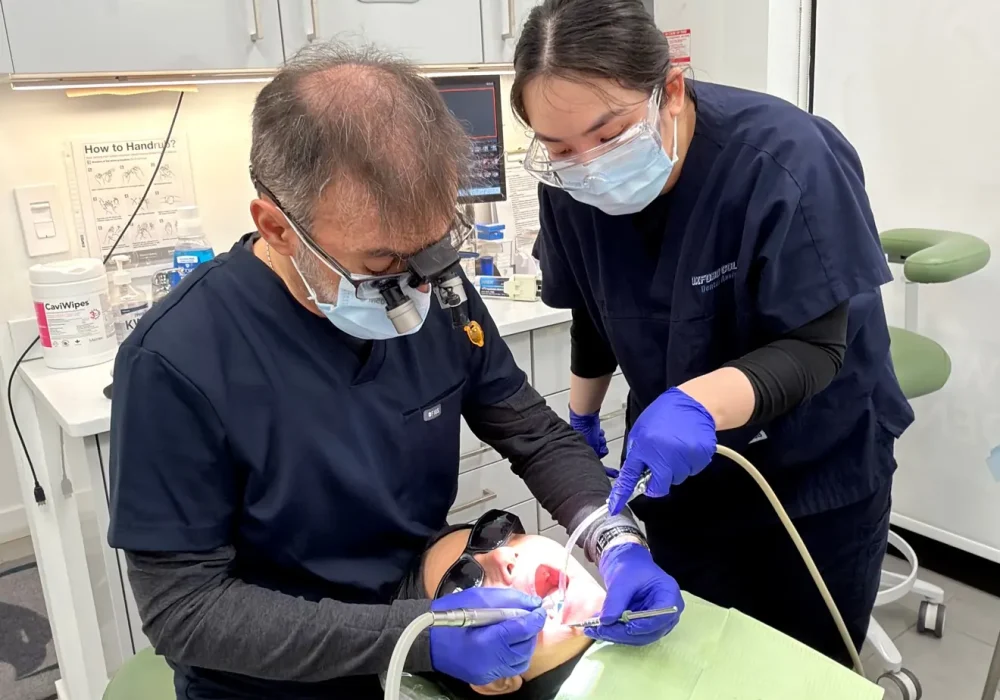
Tooth Extraction
Simple and surgical tooth extraction in Newmarket, with clear aftercare guidance.
Dentures
Full, partial, immediate and implant-supported dentures, made to fit comfortably.