Most parents book a child’s first dental visit with the same quiet question: what is actually going to happen in that chair? The honest answer is reassuring — a first visit is short, gentle and mostly about getting acquainted. Nobody is drilling, nobody is forcing anything, and if your child decides halfway through that they have had enough, that is useful information too, not a failed appointment. This page walks through the timing, the steps and the preparation that make a child’s first dental visit in Newmarket go well, and it is written the way we would explain it across the desk.
Eagle Family Dentistry provides children’s dentistry as part of general family care — our pediatric dentist in Newmarket services are provided by general dentists Dr. Saeed Meshksar and Dr. Meysam Jahanmehr, who treat children, parents and grandparents, often from the same family, in the same office.
When should the first visit happen?
The guidance from the Canadian Dental Association is that a child should see a dentist within six months of the first tooth appearing, or by their first birthday — whichever comes first. That surprises many parents, because at that age there may only be two or four teeth to look at. The point of an early visit is not the teeth that are visible today; it is catching feeding and habit patterns, checking how the mouth is developing, and making the clinic a familiar place long before there is ever a problem to fix.
If your child is already two, three or five and has never been, you have not missed a deadline that matters — book now. A later first visit is still a first visit, and we run it the same unhurried way. Reasons to come in sooner than a routine first appointment include a tooth that looks dark or has a visible hole, pain or swelling, a tooth knocked in a fall, or white or brown spots along the gumline, which can be early signs of decay.
What happens at the first visit, step by step
For babies and toddlers (roughly under three): the exam is usually done knee-to-knee. You sit facing the dentist with your child on your lap, and your child leans back so their head rests on the dentist’s knees while you hold their hands and they can still see your face. The dentist looks inside with a mirror and a good light, counts and checks the teeth that have come in, looks at the gums and soft tissues, and checks how the bite is forming. It takes a few minutes. Crying during this is normal and, frankly, helpful — an open mouth is easier to examine — and it does not mean your child is hurt or frightened for long; most toddlers settle the moment they sit back up.
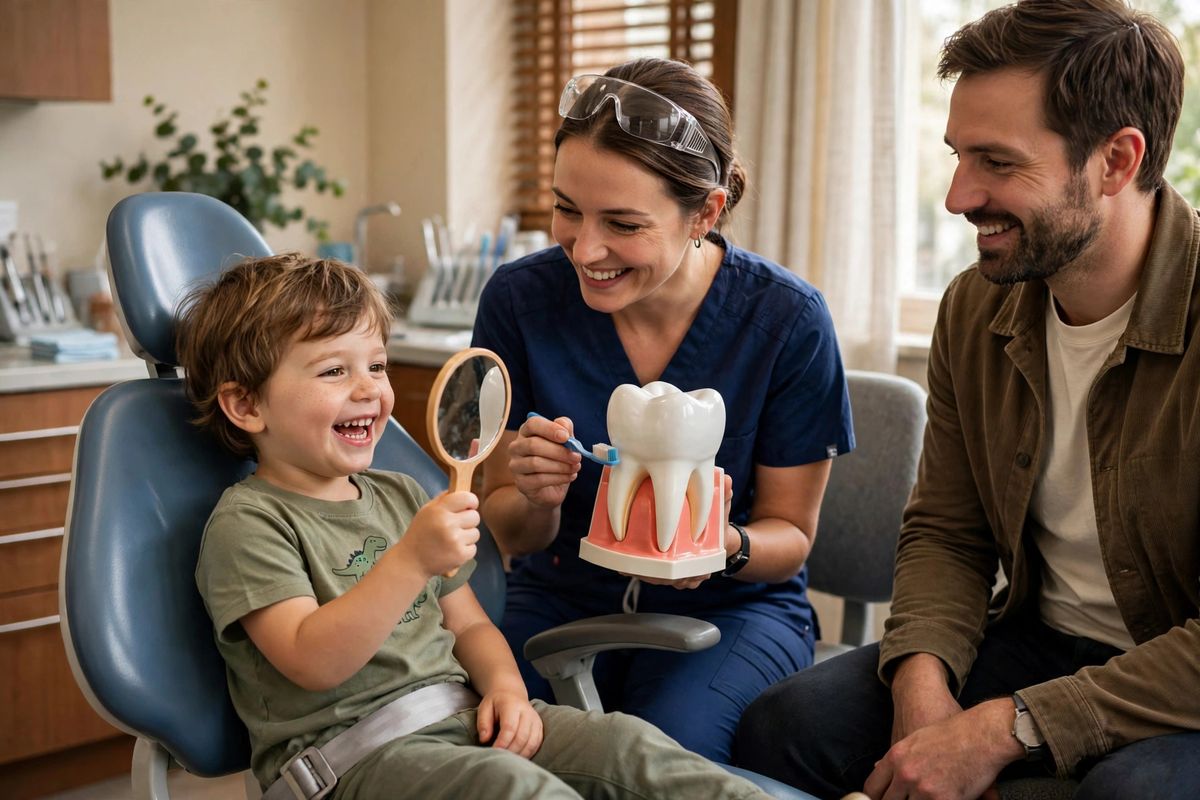
For preschoolers and older children: the visit looks more like a small version of an adult checkup. Your child sits in the chair (a parent stays right beside them), the dentist or hygienist counts the teeth aloud together with them, checks each tooth and the gums, and — if your child is willing — does a gentle cleaning to remove plaque and a polish so the teeth feel smooth. Fluoride may be applied as a varnish painted on in seconds, depending on your child’s decay risk; we explain what it is and why before we use it, and you can always decline. X-rays are not automatic at a first visit: they are taken only when there is a reason, such as teeth that touch so closely we cannot see between them, or a concern we cannot assess visually.
Throughout, the pace follows the child. We show instruments before using them, let them hold the mirror, and stop for breaks. A child who only manages a look and a count on the first visit has still had a successful visit — the next one builds on it. If nervousness is a real barrier for an older child, tell us when you book; our children’s dentistry in Newmarket appointments can be planned with extra time, and nitrous oxide is available at our clinic for children whose anxiety needs more support, after the dentist assesses whether it is appropriate.
What the dentist checks
A first-visit exam covers more than cavities. The dentist checks how many teeth have erupted and whether they are arriving in a sensible pattern; the health of the gums and the soft tissues of the mouth; early decay risk, including spots forming where plaque collects; how the upper and lower teeth meet and whether the jaw is developing evenly; and habits that shape the mouth over time — thumb sucking, prolonged pacifier use, and bottle or sippy-cup patterns, including falling asleep with milk or juice, which pools sugar against the front teeth. The Canadian Paediatric Society publishes parent guidance on these early oral-health habits, and we are happy to go through the practical parts — brushing technique with a smear of fluoride toothpaste, flossing where teeth touch, and snack and drink frequency — in terms of your child’s actual routine rather than a generic lecture.
How to prepare your child (and what not to say)
Preparation helps more than reassurance speeches. Book a morning slot if you can, when young children are rested and fed. Read a picture book about a first dental visit in the days before, and play “dentist” at home — counting each other’s teeth with a clean spoon handle works surprisingly well. Bring a comfort object if your child has one.
What not to say matters just as much. Avoid “it won’t hurt” and “don’t be scared” — children hear the words “hurt” and “scared” and wonder what they are being warned about. Avoid using the dentist as a threat (“if you don’t brush, the dentist will pull your tooth”), and avoid sharing your own dental anxieties or treatment stories in front of them; children borrow their expectations from you. Simple and neutral works: “The dentist is going to count your teeth and see how they are growing.” If you have questions or worries of your own, ask us — just, where possible, not over your child’s head in the chair.
If something is found
Sometimes a first visit does turn something up: early decay, a tooth erupting oddly, a habit that is starting to affect the bite. Here is what does not happen — your child is not rushed into treatment on the spot, and nothing proceeds without your agreement. The dentist explains what was found, how urgent it is (much of early childhood decay can be monitored or treated simply when caught at this stage), what the options are, and what can safely wait. If a case ever needs care beyond what we provide as general dentists, we will tell you plainly and help you find the right referral. You will leave with a written sense of the plan and a recommended interval for the next visit, which for most children is about six months — the same recall rhythm as a routine dental exam, adjusted when a child’s risk is higher.
Booking the first visit in Newmarket
Eagle Family Dentistry is at 340 Eagle St W, Unit 11, in Newmarket. We are open Tuesday to Friday from 10:00 a.m. to 7:00 p.m. and Saturday from 10:00 a.m. to 4:00 p.m. (closed Sunday and Monday) — Saturday and late-afternoon weekday appointments are the ones school-age families usually ask for first. To book, call us at (905) 836-6111 or use the contact page. Bring your child’s health card information and, if you have dental coverage, those details; if your family is covered under the Canadian Dental Care Plan (CDCP), tell us when you book and we will confirm how your child’s visit fits the plan before the appointment. Both of our dentists are general dentists registered with the Royal College of Dental Surgeons of Ontario — you can look any Ontario dentist up in the College’s public register — and the Ontario Dental Association offers parent resources on children’s oral health if you would like to read more before you come in.
And if the reason you are booking is not routine — a fall, a chipped or knocked tooth, pain or swelling — say so when you call. We hold same-day emergency appointments on the days we are open, and a child’s dental injury is exactly what they are for. Otherwise, we look forward to a first visit that is mostly introductions: your child meets the chair, the mirror and the team, and every visit after that one is easier.
First-visit questions parents ask us
How long does a first dental visit take?
For a baby or toddler, the exam itself usually takes only a few minutes; allow about 30 minutes for the whole appointment including paperwork and questions. For an older child having a cleaning as well, plan on roughly 30 to 45 minutes. We would rather finish early with a happy child than fill the slot.
What if my child cries or refuses to open their mouth?
Then we adapt. Crying during a knee-to-knee exam is normal and brief, and it does not harm your child. If an older child will not open up, we do not force it — we count what we can, let them explore the room and instruments, and try again at a short follow-up. A visit that ends with your child willing to come back is a success.
Should my baby really see a dentist before age one?
That is the Canadian Dental Association’s guidance — within six months of the first tooth, or by the first birthday. The visit is mainly about development, feeding habits and decay risk, and about your child knowing the clinic before anything is wrong. If your child is older and has not been yet, the right time is simply now.
Will my child need X-rays at the first visit?
Not automatically. X-rays are taken when there is a clinical reason — for example, back teeth that touch too closely to inspect between them, or a specific concern. Many first visits, especially for toddlers, involve no X-rays at all.
Is fluoride safe for young children?
Fluoride varnish painted on at the clinic is a standard preventive measure recommended by the Canadian Dental Association and the Canadian Paediatric Society, applied in a small amount that sets on contact with saliva. At home, use a rice-grain smear of fluoride toothpaste for children under three and a pea-sized amount from age three, and teach spitting rather than swallowing. If you prefer to decline fluoride, tell us — it is your decision, and we will note it.
Can I stay with my child during the appointment?
Yes. For toddlers you are part of the exam position, and for older children you are welcome to sit beside the chair. Occasionally an older child does better showing off independently — if that happens, it is their idea, and you are still steps away.
What should I bring to the first visit?
Your child’s health card information, any dental coverage details (including CDCP if your family is covered), a note of medical conditions and medications, and a comfort item if your child has one. Arriving a few minutes early keeps the start unhurried.
How often should children see the dentist after the first visit?
About every six months for most children, which matches how quickly small problems can change in a growing mouth. Children at higher decay risk may be seen more often; the dentist will recommend an interval based on your child’s teeth, not a one-size schedule.