
On this page
The short answer
Crown vs implant is really two different questions wearing one name. A crown caps and protects a tooth that is still there. An implant replaces a tooth that is gone — root and all. If your tooth can be saved, the crown is usually the answer. If the tooth is missing or cannot be saved, the implant is what rebuilds it. This guide compares both for patients in Newmarket, including the common middle case: a crown that sits on top of an implant.
For the full picture of replacement treatment, see dental implants in Newmarket.
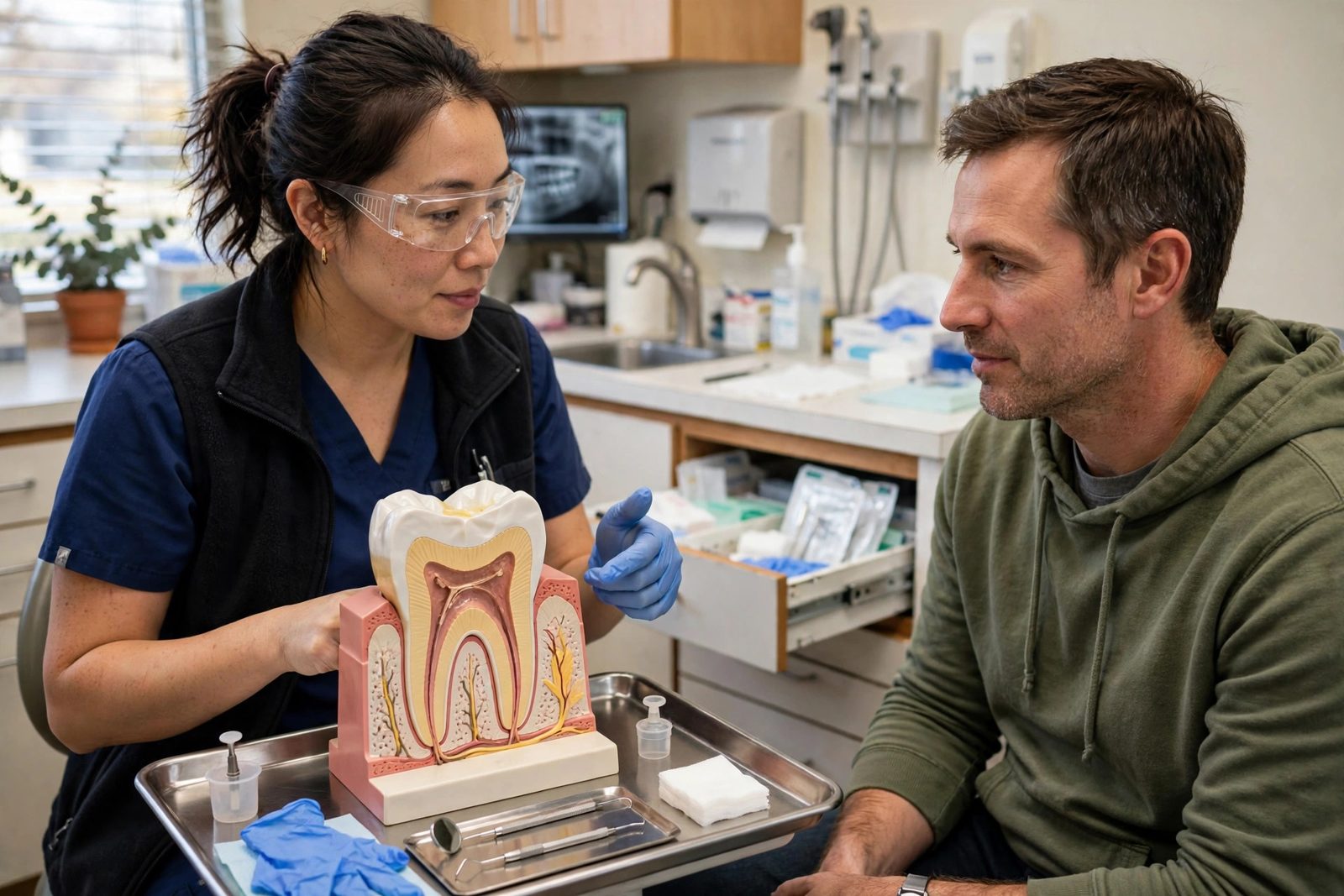
Crown vs implant, side by side
| Dental crown (on your own tooth) | Dental implant (with its own crown) | |
|---|---|---|
| What it is / how it works | A custom cap shaped like the original tooth, cemented over a prepared natural tooth to protect it and restore its shape. | A small titanium post placed in the jawbone where the root used to be; after healing, a crown is attached on top of it. |
| Typical lifespan | Systematic reviews by Sailer, Pjetursson and colleagues report roughly 94% of metal-ceramic crowns surviving at 5 years (survival of the crown, not a promise for any single tooth); many crowns last well beyond that with normal care. | Systematic reviews by Pjetursson and colleagues report 10-year survival around 95% for single implants and their crowns (survival of the implant/restoration). Individual results depend on bone, health and habits such as smoking. |
| Maintenance and care | Brush and floss normally, with care at the crown’s edge where it meets the gum. The tooth underneath can still decay, so check-ups matter. | Brush and clean around the implant like a natural tooth, including under the crown edge; professional cleaning and periodic X-rays check the bone holding it. |
| Effect on neighbouring teeth and jawbone | The natural root stays, so the bone around it is preserved. Neighbouring teeth are not touched. | The post stimulates the bone in the gap, which helps limit the bone shrinkage that follows tooth loss. Neighbouring teeth are not prepared, unlike a bridge. |
| Who it suits — and who it does not | Suits a tooth that is cracked, heavily filled, worn, or has had a root canal, but still has a sound root and enough structure. It cannot help a tooth that is missing or fractured through the root. | Suits a missing tooth, or one that must come out, where there is enough bone (or bone can be rebuilt) and general health allows a minor surgical procedure. It may not suit uncontrolled medical conditions or heavy smoking without a careful assessment first. |
| Number of visits and timeline | Usually two visits over a few weeks: preparation and impressions, then fitting. | Several stages over a few months: placement, a healing period while the post integrates with the bone, then the final crown. |
| CDCP coverage | Crowns are a service the Canadian Dental Care Plan can cover for eligible patients, subject to the plan’s rules and preauthorization. | Dental implants are not covered by the Canadian Dental Care Plan. |
How to choose
Ask one question first: can this tooth be predictably saved? If yes, a crown protects it and is the simpler, faster treatment. If the tooth is gone or unsavable, an implant rebuilds it without leaning on the neighbours. The cost of each depends on factors such as the tooth’s position, whether a root canal or bone grafting is needed, and the materials chosen — which is why we quote exactly, in writing, after an examination rather than publishing figures that cannot fit your case.
Eagle Family Dentistry offers free consultations for dental implants, orthodontic treatment and Invisalign in Newmarket — the visit covers an assessment and a discussion of your options. Same-day emergency appointments are available on open days when you call ahead. Call (905) 836-6111. Background reading: the Canadian Dental Association and the federal CDCP page.
Common questions
Is an implant stronger than a crown?
They do different jobs. A crown protects a living tooth; an implant replaces a missing one. Strength comparisons only make sense once we know whether your own tooth can be kept.
Can a crown be placed on an implant?
Yes — that is the usual finish. The implant is the root replacement; the crown is the visible tooth attached to it.
Which lasts longer, a crown or an implant?
Published systematic reviews report high survival for both at 5–10 years (about 94% at 5 years for metal-ceramic crowns; about 95% at 10 years for single implants). Those are group averages from the literature, not predictions for one mouth.
What if my tooth already has a root canal?
A crown is commonly recommended after a root canal because the tooth becomes more brittle. If that tooth later fails, an implant may become the replacement plan.
Does an implant feel like a real tooth?
Most patients say it feels close to a natural tooth for chewing once healed, though it has no living nerve, so it does not sense temperature or pressure the same way.
Does the CDCP pay for crowns or implants?
Crowns can be covered for eligible patients under plan rules with preauthorization. Implants are not covered by the CDCP. Eligibility always comes first.
How many visits will I need?
A crown is usually two visits. An implant takes several stages over a few months because the post needs healing time before the final crown is fitted.
Am I too old for an implant?
Age alone is rarely the barrier. Bone volume, general health and medications matter more, and all of that is checked at the assessment.