Braces vs clear aligners in Newmarket is the question almost every family asks at an orthodontic consultation. Both straighten teeth. They differ in discipline, diet, sports, and which movements they handle well. This comparison is written for parents and adult patients at Eagle Family Dentistry, and it is honest about who each system does not suit. It supports our orthodontic care in Newmarket page, where you can read about assessment and treatment planning in more detail.
What each option is
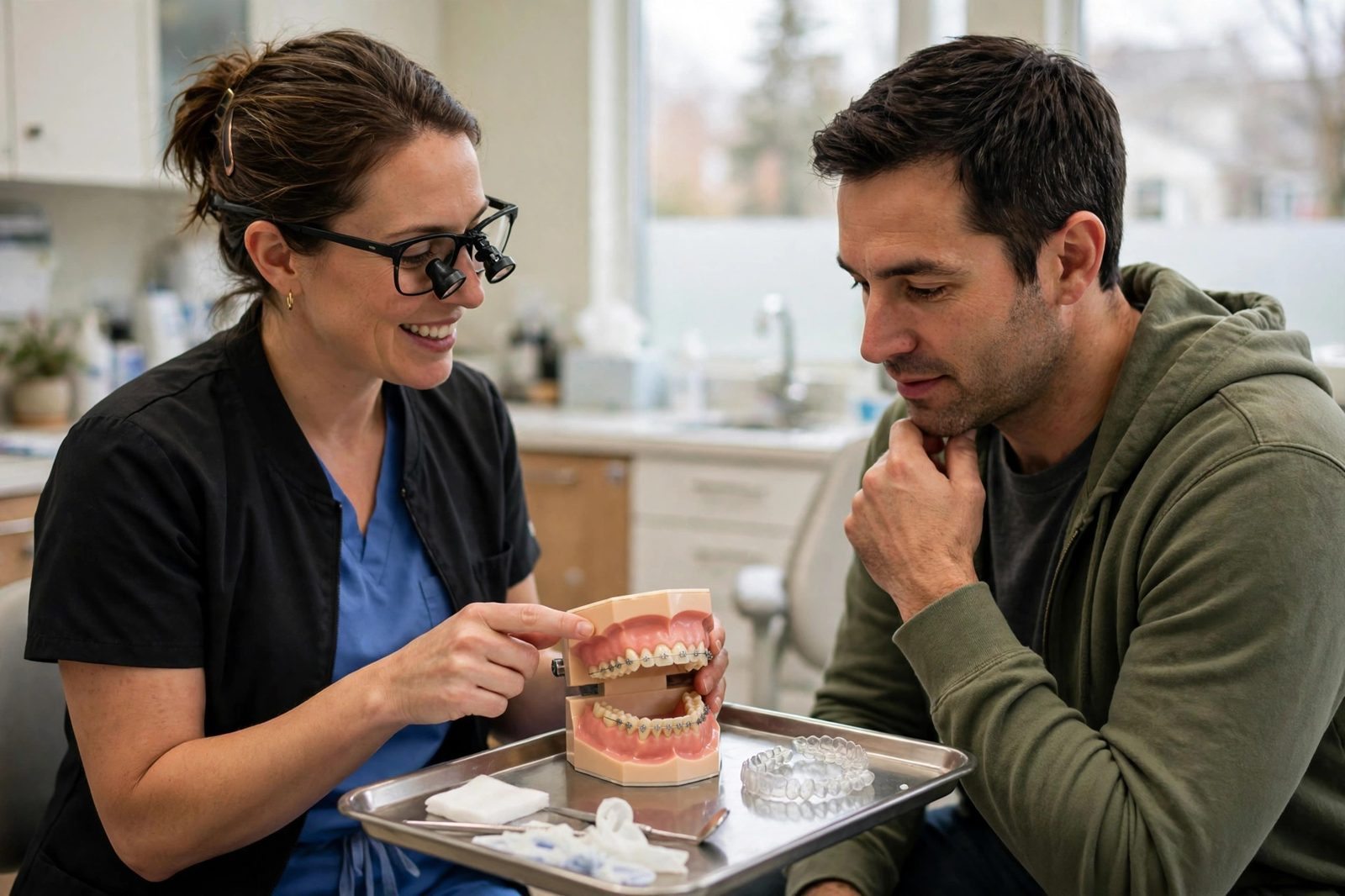
Braces use brackets bonded to the teeth and a wire that is adjusted over time to guide movement. They work around the clock because they cannot be removed. Clear aligners are a series of transparent, removable trays, changed every week or two, that nudge teeth in small steps. They only work while they are in the mouth — which means most of the day, every day. Both approaches end with retainers; teeth that are not retained will drift, whichever system moved them.
Side-by-side comparison: braces vs clear aligners
| Question | Braces | Clear aligners |
|---|---|---|
| What it is / how it works | Fixed brackets and wires, adjusted at appointments, applying continuous force day and night. | Removable transparent trays worn about 22 hours a day, changed in sequence to move teeth step by step. |
| Typical lifespan | Orthodontic results are not a product with a lifespan — they last as long as retainers are worn as directed. Professional guidance from the Canadian Dental Association and orthodontic associations is consistent: retention is lifelong if you want the alignment to hold. | The same retention rule applies. Aligners do not hold the final result by themselves; a retainer phase follows treatment, and skipping it is the most common reason aligned teeth shift back. |
| Maintenance and care | Brushing and flossing take more effort around brackets and wires; special flossers help. Sticky and very hard foods are avoided to protect the brackets. | Trays come out for eating and brushing, so normal hygiene is easier. Trays themselves need daily rinsing and cleaning, and must be stored in their case — not a napkin. |
| Effect on neighbouring teeth and jawbone | Moves teeth within the existing bone; complex rotations, vertical movements and bite corrections are handled directly by the fixed system. | Also moves teeth within the bone, but some movements — certain rotations and pulling a tooth down — are harder and may need attachments or a different approach. Growing jaws in younger teens add another variable your dentist will assess. |
| Who it suits and who it does not | Suits complex cases, younger patients, and anyone who knows they would not wear a removable tray faithfully. It does not suit patients unwilling to adapt eating habits or oral hygiene around brackets. | Suits motivated teens and adults with mild to moderate crowding who value discretion and removable trays. It does not suit patients who will leave trays out for long stretches — the treatment simply stalls — or some complex bite problems. |
| Number of visits and timeline | Adjustment visits roughly every 6 to 8 weeks; many cases run about 18 to 24 months, though simpler and more complex cases fall outside that range. | Check visits roughly every 6 to 10 weeks; timelines are similar for comparable cases, but missed wear stretches the calendar, because teeth only move when trays are worn. |
| CDCP coverage | Orthodontic treatment, including braces, is not covered by the Canadian Dental Care Plan. | Clear aligners are orthodontic treatment and are likewise not covered by the Canadian Dental Care Plan. |
How to choose
Be honest about habits first. A removable system in the hands of a forgetful wearer loses to a fixed system every time. Then look at the movements your teeth actually need: your assessment includes an examination and imaging, and some bites genuinely need the control of braces, while many crowding cases can be treated either way. Lifestyle matters too — contact sports, wind instruments, public-facing work, and how a teen feels about visible brackets all count. At Eagle, orthodontic treatment is provided by our general dentists; where a case needs a registered specialist, we will say so and arrange a referral rather than stretch a case beyond what we should treat. Same-day emergency appointments are available on open days if an orthodontic problem — a poking wire, a lost tray with pain — cannot wait; call ahead to confirm the day’s availability.
Factors that affect cost
We do not publish prices, because the honest figure depends on case complexity, treatment length, and whether both arches are treated. Many major insurance plans include some orthodontic coverage — your own plan’s rules decide, and we will help you check. You receive an exact written quote before treatment begins. Call Eagle Family Dentistry in Newmarket at (905) 836-6111 to book an assessment.
Frequently asked questions
Are clear aligners faster than braces?
Not reliably. For comparable cases the timelines are similar. Aligners only look faster when wear is excellent; every day a tray spends in its case is a day the teeth are not moving, which stretches aligner treatment in real life.
Do braces or aligners hurt?
Both cause pressure and tenderness for a few days after adjustments or a tray change — teeth are being moved, and we will not promise a pain-free experience. Ordinary pain relief and soft foods get most patients through those days. Sharp pain from a broken wire or cracked tray is different: call us.
Can my teenager switch from aligners to braces if it is not working?
Yes, and it happens. If trays are not being worn, teeth stop tracking the plan, and switching to a fixed system is often the sensible reset. There is no shame in it — matching the system to the person is the whole point of the assessment.
What age can orthodontic treatment start?
An initial orthodontic assessment is sensible around age 7, when the first adult molars and front teeth are in, because some bite problems are easier to guide while a child is growing. Many treatments still begin in the early teen years, and adults can be treated at almost any age if teeth and gums are healthy.
Will I need retainers after treatment?
Yes — after braces and after aligners alike. Teeth have a lifelong tendency to drift toward their old positions. Retainers, worn as directed (often nightly long-term), are what protect the result. Budget for them as part of treatment, not an optional extra.
Are braces or aligners covered by the CDCP or insurance?
The Canadian Dental Care Plan does not cover orthodontics at all. Private insurance sometimes does, often with a lifetime orthodontic maximum and an age limit. We will help you verify your plan before you commit.
Can aligners fix an overbite?
Mild to moderate overbites can often be improved with aligners, sometimes with small attachments or elastics. Severe bite problems, especially where jaw growth is involved in a younger patient, may need braces or specialist care. Your assessment gives a case-specific answer.
What if a bracket breaks or I lose a tray?
Call us. A broken bracket can usually wait a few days if it is not causing pain — cover sharp edges with orthodontic wax — but it should be repaired promptly. For a lost tray, we will advise whether to move to the next tray or wear the previous one until a replacement is made.
Sources and further reading
- Canadian Dental Association (CDA) — patient guidance on dental treatments.
- Ontario Dental Association (ODA) — patient resources for Ontario.
- Canadian Dental Care Plan — Canada.ca — official coverage information.