It usually starts with something small. A sharp twinge when you bite down on something crunchy. A rough edge your tongue keeps finding. Or nothing you can feel at all — just your dentist pausing during a checkup to say, “There’s a crack in this tooth.”
A cracked tooth is one of the most common reasons a crown gets recommended, and one of the most confusing. Does a crack always need a crown? Can it wait? What happens if you leave it? This guide answers those questions the way we’d want them answered honestly: how teeth crack, how to tell a crack from a chip, the signs a crack is getting worse, and when a crown genuinely is the thing that saves the tooth — plus the cases where a crown is not enough. If you’re in Newmarket and you’ve just been told you have a cracked tooth, start here, then bring your questions to an assessment.
- How Teeth Crack (and Why It Often Happens Silently)
- Cracked Tooth vs. Chipped Tooth vs. Broken Cusp — What’s the Difference?
- Signs Your Crack Is Getting Worse
- Why a Crown Protects What’s Left
- When a Crown Is NOT Enough (Root Canal First, or Extraction)
- What the Crown Process Involves, Visit by Visit
- Living With a Crown: What It Can and Can’t Handle
- References
- Frequently Asked Questions About Cracked Teeth and Crowns
How Teeth Crack (and Why It Often Happens Silently)
Teeth are strong, but they are not unbreakable, and they flex a tiny amount every time you chew. Over years, that everyday stress adds up — especially on teeth that already carry large fillings, because a big filling leaves less natural tooth structure to absorb the force.
The most common causes of cracks:
- Biting something unexpectedly hard — an olive pit, a popcorn kernel, ice, hard candy.
- Large or aging fillings that no longer support the cusps (the pointed parts of the tooth) around them.
- Grinding or clenching, often during sleep, which loads teeth for hours at a time.
- Age — teeth accumulate decades of stress, and cracks become more common in adults over 40.
- A tooth weakened by root canal treatment, which is why those teeth are so often crowned afterwards.
Why “silently”? A crack doesn’t always hurt, and hairline cracks can be invisible on the surface and hard to spot even on an X-ray. Many cracks are found during a routine exam, or only once they deepen enough to start flexing when you bite — which is when the classic symptom, a sharp pain on biting or on releasing the bite, shows up. A crack that is silent today is not necessarily stable: cracks do not heal, and they tend to extend under load. That is why the plan for a cracked tooth is based on where the crack is, how deep it runs, and whether the nerve is involved — all of which an assessment with imaging can show.
Cracked Tooth vs. Chipped Tooth vs. Broken Cusp — What’s the Difference?
These three get mixed up constantly, and they are not the same problem:
- A chip is a small piece of enamel broken off an edge — common on front teeth after a knock or biting something hard. Chips are often mostly cosmetic, though a larger chip can expose the sensitive layer underneath. Many chips are repaired with bonding or a filling rather than a crown.
- A broken cusp is when one of the tooth’s chewing points breaks off, usually around a large filling. The tooth often doesn’t hurt at first because the nerve isn’t involved, but the remaining structure is weak and unprotected.
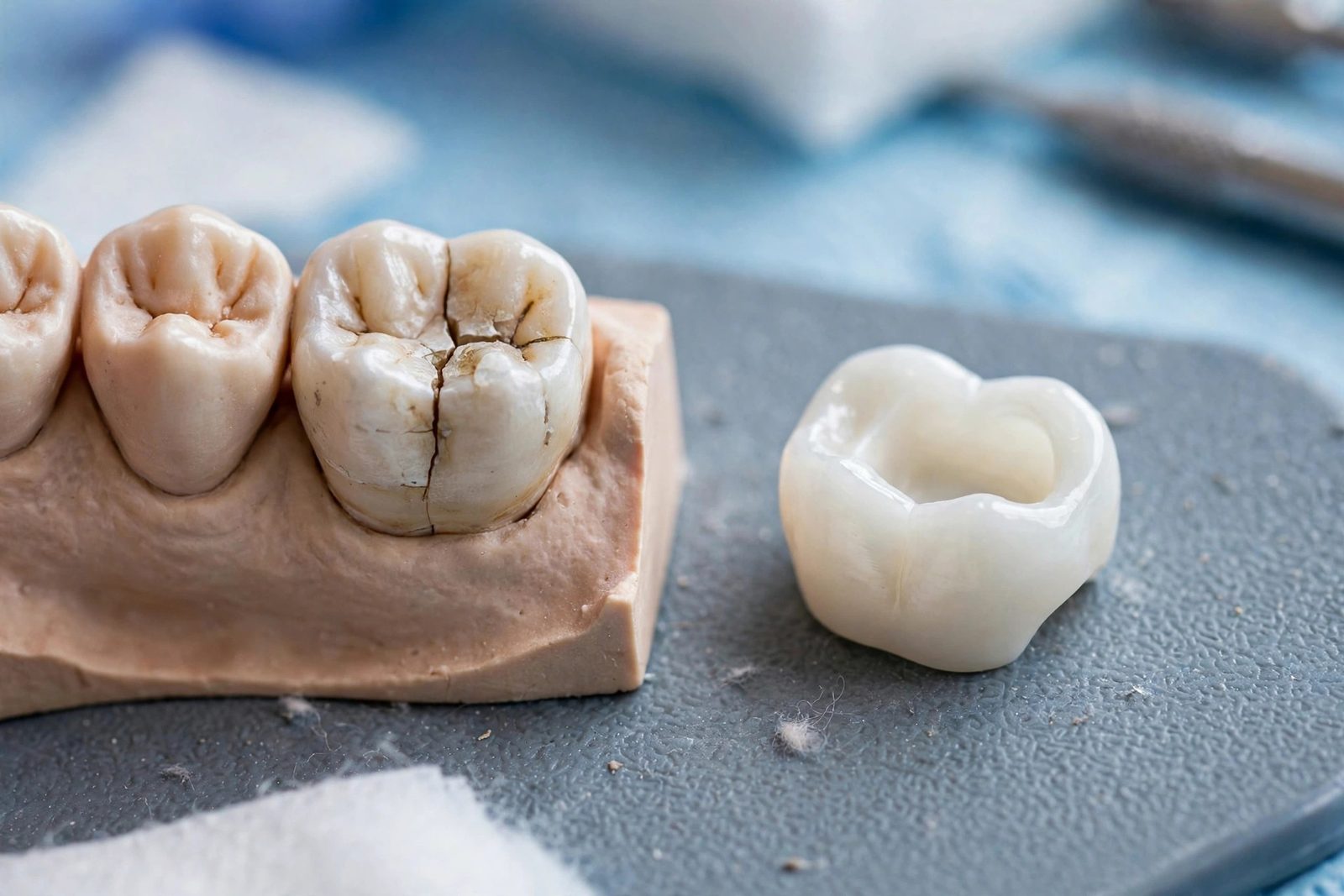
- A cracked tooth has a fracture line running into the tooth — from the chewing surface downward, sometimes below the gumline. Unlike a chip, the tooth is still in one piece, but the crack flexes under pressure, irritates the nerve, and can deepen until the tooth splits. Vertical cracks that reach the root are the most serious kind.
The practical difference: chips and broken cusps are about missing structure; cracks are about compromised structure that is still there but failing. That is exactly the situation a crown is designed for — it holds the remaining tooth together. Whether your tooth has a chip, a broken cusp or a true crack decides the treatment, and it often can’t be judged from a photo or a description. It takes an exam, sometimes with magnification and imaging.
Signs Your Crack Is Getting Worse
A stable, shallow crack under review is one thing. These signs mean the crack — or the nerve inside the tooth — is progressing, and the tooth should be seen promptly rather than watched:
- Pain when biting, or a sharp pain when you release the bite — the classic cracked-tooth symptom.
- Sensitivity to hot, cold or sweet that lingers after the source is gone — a sign the nerve is becoming inflamed.
- Pain that comes and goes and is hard to pin to one tooth.
- Swelling of the gum near the tooth, or a small pimple-like bump on the gum — possible signs of infection.
- A piece of the tooth breaking away, or a crack you can now see or feel with your tongue.
- Pain when chewing on one side only, or catching yourself avoiding that side.
One honest warning: a tooth that stops hurting after weeks of symptoms has not necessarily healed. It can mean the nerve has died — after which infection can develop quietly at the root tip. If a cracked tooth goes silent after being symptomatic, it still needs to be assessed. If you have swelling, fever, or pain you can’t manage, treat it as urgent and call (905) 836-6111 the same day.
Why a Crown Protects What’s Left
A dental crown is a custom-made cap that covers the entire visible part of the tooth. For a cracked tooth, its job is mechanical: it binds the tooth together so the crack can’t flex open every time you bite. Think of it as a splint that never comes off — chewing forces are spread over the whole covered tooth instead of concentrating at the crack line.
That protection does two things. First, it stops the crack from being pried wider with every meal, which is how most cracks eventually split a tooth in two. Second, it seals the tooth, keeping bacteria out of the crack and away from the nerve. A crown also restores the tooth’s shape, so you can chew on it normally again.
What a crown does not do is heal the crack. The fracture line is still in the tooth underneath; the crown protects it from the forces that would extend it. That distinction is why diagnosis comes first — a crown is the right protection when enough sound tooth remains to hold it, and the wrong plan when the crack has already gone too far (next section). For the full picture of how crowns work and what they’re made from, see our page on dental crown treatment in Newmarket.
When a Crown Is NOT Enough (Root Canal First, or Extraction)
Honesty matters here, because a crown is not the answer to every cracked tooth:
- When the crack has reached the nerve. If the pulp (the nerve and blood supply inside the tooth) is inflamed or infected, covering the tooth with a crown traps the problem inside. The usual sequence is root canal therapy first — the infected tissue is removed and the inside of the tooth is cleaned and sealed — and then a crown to protect what is now a more brittle tooth. Many root-canal-treated back teeth end up crowned for exactly this reason.
- When the crack runs deep below the gumline or splits the root. A tooth cracked vertically through the root generally cannot be saved, because there is no sound structure left for a crown to hold and no way to seal the fracture. In that case the realistic option is removing the tooth and planning its replacement.
- When too little sound tooth remains. If decay or fracture leaves very little healthy structure above the gum, a crown may have nothing reliable to grip.
None of these can be decided from symptoms alone. At the assessment, your dentist examines the tooth, tests the bite and the nerve, and reviews imaging to see how far the crack extends. Sometimes the honest answer is “crown it and monitor”; sometimes it is “root canal, then crown”; occasionally it is “this tooth can’t be saved.” A good treatment plan names which one — and why — before any work begins.
What the Crown Process Involves, Visit by Visit
The exact sequence is confirmed at your assessment — including how many visits your case needs and which crown approach suits the tooth. In general, the process looks like this:
Visit one — assessment and preparation. Your dentist confirms the diagnosis, examines the crack, and reviews X-rays. If a crown is the plan, the tooth is numbed with local anaesthesia, shaped so the crown can fit over it, and scanned or moulded so the crown can be made to match your bite and the neighbouring teeth. If the tooth will be without its final crown for a period, a temporary crown protects it in the meantime — it looks like a tooth and keeps the prepared tooth safe, but it is not made for heavy-duty chewing.
Between visits. You chew gently on the temporary, avoid sticky foods that could pull it off, and keep the area clean. If a temporary ever comes loose, call the clinic rather than trying to fix it yourself.
The fitting visit. The temporary is removed, the final crown is tried in, checked against your bite and the teeth beside it, adjusted as needed, and then fixed permanently in place. Your dentist checks that you can bite and floss around it normally before you leave.
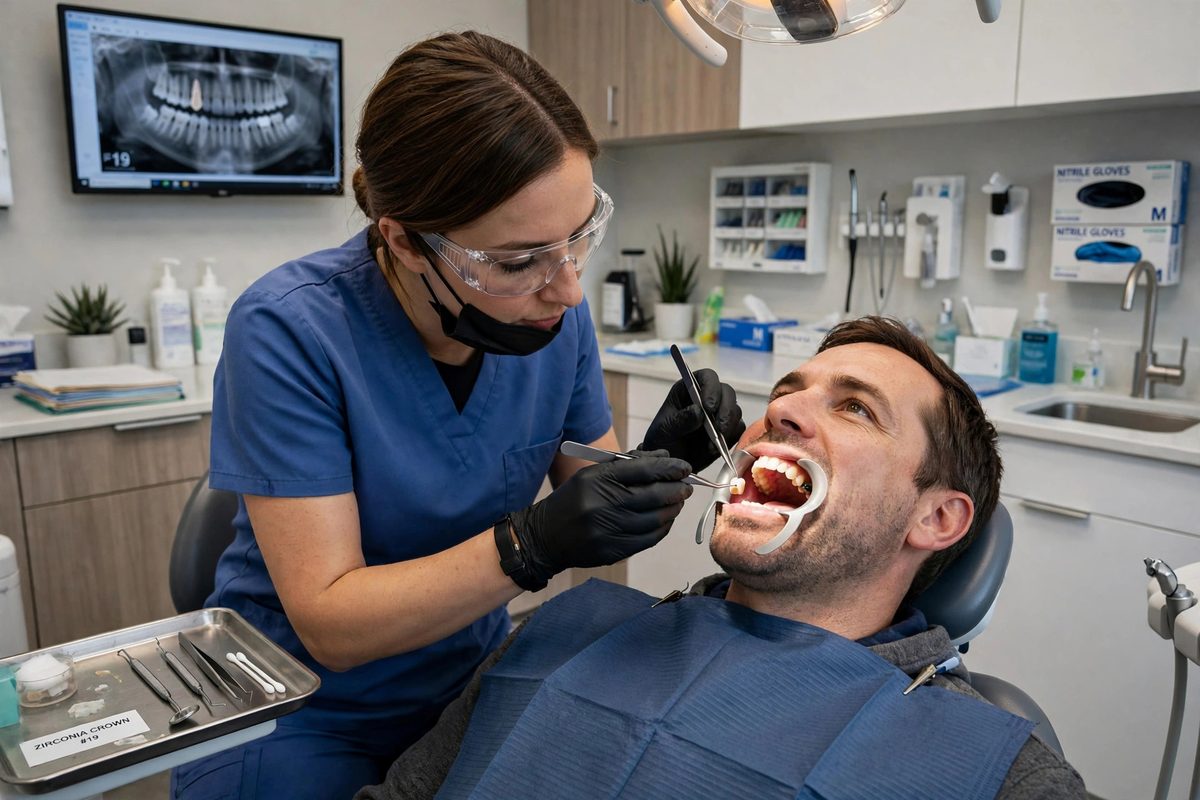
A note on timing, because patients ask: you may see other clinics advertise crowns completed in a single visit with chairside milling technology. Whether that approach is used depends on the clinic and the case — what matters for your tooth is that the method is chosen for the crack in front of us, and your dentist will explain the plan and the number of visits at your assessment before anything starts. If dental visits make you anxious, tell us: Eagle offers nitrous oxide (laughing gas) to help patients relax during treatment — you stay awake and aware, just calmer; it is the only sedation we offer, and we will never describe it as anything more than it is.
Living With a Crown: What It Can and Can’t Handle
A well-made crown on a sound tooth is meant to be used like a tooth: eat normally, brush and floss around it (sliding the floss out to the side rather than pulling up, so you don’t lift the crown’s edge), and keep up your regular checkups so the tooth under the crown is monitored — the natural tooth at the crown’s margin can still decay, which is the most common reason crowns eventually need attention.
What a crown can’t handle is being treated as a tool or a test of strength: cracking ice, opening packaging, chewing pens, or grinding through the night unprotected. If you grind your teeth, ask about a night guard — it protects crowned and natural teeth alike. And how long does a crown last? Honestly: it varies. Many crowns serve for years with normal care; biting forces, grinding, hygiene and the condition of the tooth underneath all affect lifespan, and no dentist can promise a specific number of years for your tooth. What we can promise is to check it at every visit and tell you plainly if it ever needs attention. (And if a crown ever does come off, that’s a different situation with its own first steps — see our guide to what to do if a crown falls out.)
If you’ve been told you have a cracked tooth — or you have the bite-pain symptoms described above — the next step is an assessment, not a guess. Call Eagle Family Dentistry at (905) 836-6111 or contact us to book. The doctor will examine the tooth, show you what the imaging shows, and confirm your treatment plan and your cost at your visit, after the assessment — before any treatment begins.
References
The guidance in this article reflects Canadian dental practice and patient-education resources from the Ontario Dental Association, the Canadian Dental Association and the Royal College of Dental Surgeons of Ontario (RCDSO). Dentists in Ontario are licensed by the RCDSO, and patients can verify a dentist’s registration on the RCDSO website.
Frequently Asked Questions About Cracked Teeth and Crowns
Can a cracked tooth heal on its own?
No. Unlike a broken bone, a cracked tooth cannot heal or knit itself back together — enamel and dentine have no living repair mechanism. A shallow crack may stay stable for a long time, and some hairline cracks (called craze lines) affect only the outer enamel and need nothing more than monitoring. But a true crack into the tooth will not close, and under chewing pressure it tends to deepen over time. That is why the decision is never “wait for it to heal” — it is protect it, treat what it has damaged, or monitor it knowingly with your dentist.
Is a crown after a root canal always needed?
Not in every single case, but very often — particularly for back teeth. A tooth that has had root canal treatment no longer has a living nerve, and it is typically more brittle and more heavily filled than a healthy tooth, while back teeth take the strongest chewing forces. A crown protects that remaining structure from fracturing. Front teeth, which take less force and sometimes need only a smaller restoration, are judged case by case. Your dentist decides based on how much sound tooth is left and where the tooth sits in your bite — and will tell you the reasoning either way.
How long do crowns last?
There is no honest single number. Many crowns serve for years — often well beyond a decade — with normal care, but lifespan depends on the condition of the tooth underneath, your bite forces, whether you grind your teeth, and how well the crown’s margins are kept clean. The tooth under a crown can still decay, and a crown can chip, wear or come loose. What protects your investment is boring but effective: brush and floss around it, wear a night guard if you grind, and keep regular checkups so small problems at the margin are caught early. Any dentist who guarantees you an exact lifespan for a crown is promising something dentistry can’t promise.
Does the CDCP cover crowns?
Crowns are among the services listed under the Canadian Dental Care Plan (CDCP) for eligible patients, but coverage is criteria-based: eligibility is confirmed first, the plan’s rules and fee guide apply, and crowns require preauthorization — meaning approval is sought before treatment. Coverage is a percentage of the plan’s established fees, not automatically the full cost of treatment. Because the details matter and they are specific to your situation, we have a dedicated guide that walks through them: see CDCP coverage for dental crowns. If you are a CDCP patient with a cracked tooth, bring your information to your assessment and the team will explain exactly how the plan applies to your treatment before anything begins.
My cracked tooth doesn’t hurt — can it wait?
Sometimes, briefly — but “no pain” is not the same as “no problem.” Many cracks are painless until they deepen, reach the nerve, or the tooth splits, and treatment is simpler and more predictable before that happens. The safe version of waiting is planned monitoring: your dentist has examined the crack, judged it shallow and stable, and set a review point. The risky version is assuming a silent tooth is a healthy one — including a tooth that hurt for weeks and then stopped, which can mean the nerve has died rather than healed. If you know you have a crack and it hasn’t been assessed, book the assessment; then decide about timing with the full picture.
Crown or filling — how does the dentist decide?
It comes down to how much sound tooth is left and how the forces land on it. A filling repairs a contained area — a chip, a small cavity, a modest break — and works when the surrounding cusps are strong. A crown is recommended when the damage undermines the tooth’s structure: a crack running into the tooth, a broken cusp, a very large old filling, or a tooth weakened by root canal treatment. In those cases a filling alone leaves the weakened walls to flex under chewing, which is how teeth split. Your dentist will show you what the exam and imaging show and explain which side of that line your tooth falls on.
What happens if I do nothing about a cracked tooth?
The honest answer is a range, not a certainty. Some shallow cracks stay unchanged for years. But the common path of an untreated true crack is gradual: the crack deepens, bacteria reach the nerve, and you move from occasional bite pain to pulp inflammation, possible infection or abscess — and in the worst case the tooth splits below the gumline and cannot be saved at all. Treatment also escalates along that path: a crown today can become a root canal plus crown later, or an extraction and a replacement tooth after that. Doing nothing is a gamble on the shallow end of that range; an assessment tells you which end your tooth is actually on.
Will getting a crown hurt?
The tooth is numbed with local anaesthesia before it is shaped, so the preparation itself is done with the area numb — the same as for a filling. Afterwards, some sensitivity in the treated tooth for a few days is common, especially to temperature or biting, and it settles as the tooth calms down; your dentist will tell you what to expect for your case. If you feel anxious about dental treatment in general, tell us when you book: Eagle offers nitrous oxide (laughing gas), which helps you relax during the appointment while you stay awake and able to respond. It is the only form of sedation we offer — we do not provide IV sedation or general anaesthesia.